
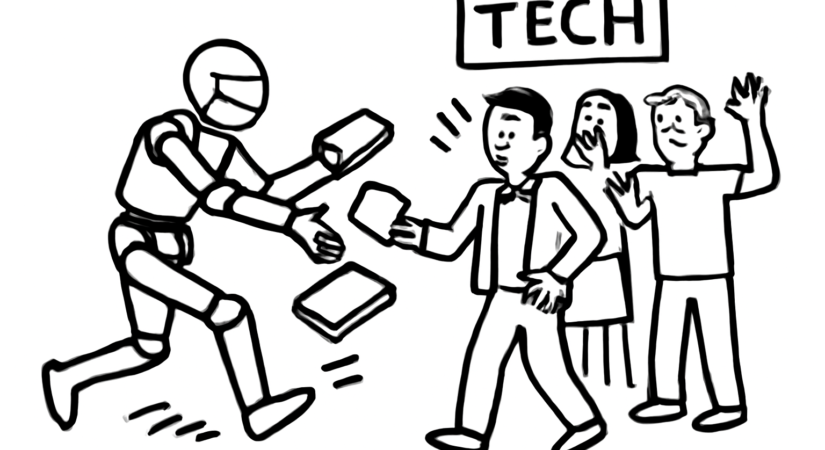
Tesla’s Optimus humanoid robot is facing new scrutiny after a leaked video from the company’s “Autonomy Visualized” event in Miami in early December 2025 showed the machine dramatically failing during a public demonstration.
In the clip, recorded at an autopilot technology showcase, an Optimus unit appears to be autonomously handing out water bottles to attendees before knocking over the supplies, raising its arms in apparent surprise, and toppling backward. The sequence quickly spread across social media, where viewers treated it as physical comedy but critics said it highlighted deeper problems in Tesla’s robotics program and the gap between its promises and current performance.
Those concerns are sharpened by CEO Elon Musk’s long-running projections for Optimus. In February 2025, Musk said the bipedal robot alone could eventually generate more than $10 trillion in revenue. After a series of stumbles, including the Miami incident, analysts and observers are increasingly skeptical of such forecasts.
The video has also revived questions about how autonomous Tesla’s demonstrations really are. Some online commentators noted that Optimus appears to move its hands toward its head just before falling, interpreting the gesture as mimicking a human operator removing a VR headset rather than expressing any simulated emotion. Their suspicions are fueled by previous reports that Tesla relied on remote operators for Optimus showcases, including during its “We, Robot” event in October 2024, according to the Los Angeles Times.
Neither Tesla nor Musk has publicly addressed the latest mishap. On an October 2025 investor call, however, Musk promoted Optimus’s expanding capabilities, pointing to an appearance “at the Tron premier doing kung fu” alongside actor Jared Leto, as reported by Fortune. Earlier, he had insisted in an X post that the robot’s martial arts moves were “AI, not tele-operated.”
Whether or not the Miami event amounted to what outlet Electrek called a potential “Wizard of Oz moment,” the incident raises fresh questions for investors trying to assess how close Tesla is to delivering a fully autonomous humanoid robot. Musk has previously described Optimus as potentially “the biggest product ever” for the company.
The fall comes after Tesla released a string of polished clips highlighting Optimus’s improved mobility, including an X video of the 160-pound robot hitting a new personal speed record in a lab. But a July 2025 report by The Information said Tesla remained far short of its stated goal of building 5,000 Optimus units by the end of 2025, with total production still only in the hundreds. In November 2025, Tesla said it aimed to start production of its Gen 3 Optimus line in 2026, targeting a price of about $20,000 per robot.
The stakes are significant. Tesla is positioning Optimus at the center of a broader race to build humanoid robots that could reshape manufacturing, logistics, and other labor-intensive industries. Morgan Stanley has estimated the sector could grow into a $5 trillion market, with as many as 1 billion humanoid robots in use by 2050. Musk has argued since at least June 2024 that Optimus could eventually push Tesla’s market capitalization to around $25 trillion.
Other U.S. companies are also betting heavily on embodied AI. Startup Figure AI counts OpenAI, Nvidia, Microsoft, Intel, and Amazon among its investors. Meta is reportedly prepared to spend billions of dollars on its “Metabot” project and the AI systems behind it, according to The Verge. Alphabet launched its Gemini Robotics program in March 2025 to develop embodied AI software, while Boston Dynamics, majority-owned by Hyundai, remains a prominent player in advanced robotics.
Tesla also faces intense competition from China, where humanoid robotics has become a strategic priority. Companies such as EngineAI Robotics, Unitree, and UBTech are part of a national push to advance embodied AI, with potential applications in factories and defense. China now has about 150 embodied AI manufacturers, which collectively attracted more than $5 billion in investment in 2025 alone—roughly equal to the country’s total in the previous five years combined.
Some analysts worry that this surge of capital may be outpacing actual technological progress, raising the risk of a bubble. Industry figures told The Wall Street Journal that there remains a substantial gap between eye-catching demonstration videos and reliable, commercially viable products.
The viral Optimus stumble underscores that divide. For now, at least, a future filled with fully autonomous humanoid helpers—or an AI robot uprising—still appears far away.